


If you face a difficult tooth extraction, you want the safest option available. Oral surgeons train longer, handle complex anatomy, and use advanced sedation and surgical tools, so they typically lower the risk of complications in tricky cases. Choosing a specialist can mean a smoother procedure and fewer surprises.
You’ll want care that covers planning, surgery, and follow-up under one team. An oral surgeon can manage wisdom teeth, teeth near nerves or sinuses, and badly broken teeth with skills and equipment a general office may not have, which helps protect your health and speed recovery.
Key Takeaways
- Oral surgeons offer extra training and tools for high-risk extractions.
- Specialists reduce surgical risks with targeted planning and sedation.
- Comprehensive surgical care supports safer recovery and fewer complications.
Understanding the Differences Between Oral Surgeons and General Dentists
You will learn who has extra surgical training, what procedures each typically treats, and which credentials show advanced expertise. This helps you choose the right clinician for complex tooth removals and jaw-related surgery.
Education and Surgical Training
Oral surgeons complete dental school, then enter a surgical residency that usually lasts 4–6 years. During residency they train in hospital settings, manage trauma cases, learn general anesthesia, and perform thousands of surgical procedures.
This hands-on surgical training gives them experience with difficult tooth extractions, bone grafts, and jaw surgery.
General dentists finish dental school and focus on preventive and restorative care. Many can remove simple teeth and place routine implants, but they typically lack the extended hospital-based surgical residency that oral and maxillofacial surgeons (OMS) complete.
If a case looks complex (impacted wisdom teeth, nearby nerves, or limited bone) an oral surgeon’s residency experience makes management safer.
Scope of Practice and Expertise
General dentists handle cleanings, fillings, crowns, routine extractions, and basic implant placement. You will usually see them first for exams and minor problems. They refer to specialists when a case involves significant surgical risk, advanced anesthesia, or reconstructive work.
Oral surgeons focus on surgical problems of the mouth, face, and jaws. They routinely treat impacted teeth, facial trauma, bone grafting for implants, corrective jaw surgery, and complex infections. They also provide deeper sedation and general anesthesia.
When your case involves hard-to-access teeth, nerve proximity, or previous surgery complications, an oral surgeon’s daily practice with these conditions reduces your surgical risk.
Oral and Maxillofacial Surgery Credentials
Look for the title “oral and maxillofacial surgeon” or “OMS” to confirm specialized training. Many OMS specialists hold a DDS or DMD plus completion of their surgical residency.
Some also earn board certification from the American Board of Oral and Maxillofacial Surgery, which shows they met extra standards for clinical skill and knowledge.
General dentists are licensed to practice after national and state exams but do not hold OMS residency credentials. Some dentists pursue additional courses in sedation or implant surgery, which can improve care for simpler cases.
For truly complex extractions, check for the oral surgeon’s residency history, hospital privileges, and board certification to ensure you have the right surgical team.
Compare oral surgeon vs dentist for extractions with a trusted Virginia oral surgery team.
Types of Tooth Extractions and When to Choose a Specialist
You will learn the main types of tooth extraction and the specific problems that usually need a specialist. This helps you pick the right provider for safer care and fewer surprises.
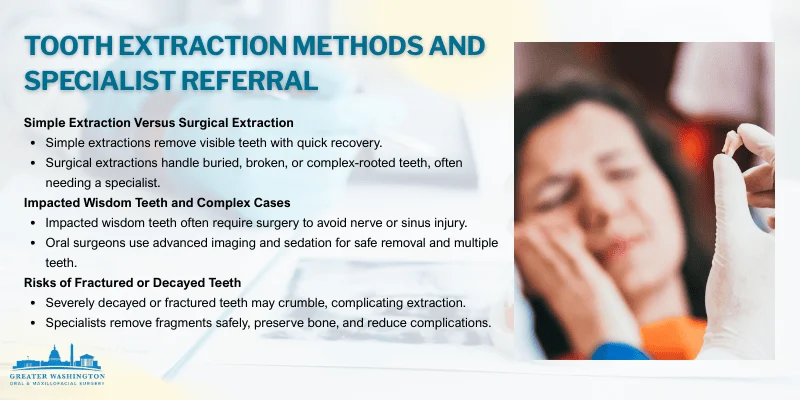
Simple Extraction Versus Surgical Extraction
A simple extraction removes a tooth that you can see in the mouth. Your dentist uses tools like an elevator and forceps after numbing the area. Recovery is usually quick, with mild pain and swelling for a few days. Your dentist can handle most simple extractions safely.
A surgical extraction is needed when a tooth is below the gumline, broken at the gum, or has roots that curve or split. The provider makes a small incision and may remove some bone to reach the tooth. Oral surgeons train for this work and use advanced imaging and sedation options.
Choose a specialist when X-rays show root problems, the tooth is partially buried, or your medical history raises surgical risks.
Impacted Wisdom Teeth and Complex Cases
Impacted wisdom teeth sit trapped against bone, other teeth, or soft tissue. They can cause pain, infection, or damage to nearby teeth. Extracting these often needs a surgical approach because the tooth position can hide roots or sit near the sinus or jaw nerve.
Impacted third molars account for the majority of surgical tooth extractions in the United States.
An oral surgeon evaluates impacted teeth with 3D or panoramic X-rays and plans the removal to avoid nerve injury and sinus complications. They offer IV sedation or general anesthesia, which helps if you have anxiety or need multiple teeth removed.
Ask for a referral to an oral surgeon when your wisdom teeth are impacted, pain is repeated, or nearby teeth show decay.
Risks of Fractured or Decayed Teeth
Broken or badly decayed teeth can crumble during a pull, leaving fragments in the socket. That makes the extraction harder and raises infection risk. A general dentist can manage some fractured teeth but may refer you if the roots are short, curved, or split.
Oral surgeons handle difficult root shapes and remove fragments with surgical tools. They also place grafts or plan for future implants when bone is damaged.
If your tooth is fractured at the gum line, has large decay under the gum, or X-rays show unusual root anatomy, seeing a specialist reduces the chance of repeat procedures and complications.
Not sure who should remove your tooth? Schedule an oral surgery consultation today.
Safety Advantages of Oral Surgeons in Complicated Extractions
Oral surgeons bring extra training, tools, and team practice to reduce risk and keep you comfortable. They focus on safe anesthesia choices, prepared emergency care, and careful work near nerves and sinuses.
Advanced Anesthesia and Sedation Options
Oral surgeons can offer a full range of anesthesia: local anesthesia, IV sedation, and general anesthesia. You get a tailored plan based on your medical history, anxiety level, and the extraction’s complexity.
For example, IV sedation allows you to remain semi-conscious and relaxed while the surgeon monitors your vital signs continuously.
You receive pre-op screening (medications, heart/lung history) and intra-op monitoring (blood pressure, oxygen, EKG when needed). This lowers the chance of adverse reactions compared with clinics that use only local blocks.
Post-op recovery plans include oxygen support, observation time, and written instructions for pain meds and activity so you leave stable and informed.
Management of Medical Emergencies
Oral surgeons train in hospital-like emergency protocols and often work where advanced resuscitation equipment is available. They rehearse airway management, IV access, and emergency drug use, which helps if you develop an allergic reaction or cardiac event.
The surgical team practices clear roles: one person manages the airway, one runs meds, and one documents.
Clinics with oral surgeons usually keep emergency kits, crash carts, and direct hospital transfer plans. That structure cuts delay if something goes wrong and gives you safer care than a small office with limited emergency readiness.
Precision with Vital Anatomy Nearby
When teeth sit near nerves or the sinus, a small mistake can cause long-term problems. Oral surgeons use detailed imaging (like CBCT) to map roots, the inferior alveolar nerve, and the maxillary sinus before touching tissue.
This lets them choose techniques such as tooth sectioning or bone removal that reduce force and nerve stretch.
They also use magnification, ultrasonic instruments, and controlled bone removal to limit trauma. If a nerve is at risk, surgeons will take extra steps; blocking only necessary areas, using gentler instruments, or planning staged surgery.
That precision lowers the chance of numbness, sinus communication, or broken roots left behind.
Comprehensive Care and Additional Services
Oral surgeons offer more than the extraction itself. You get services that help protect bone, prepare for implants, and keep your overall treatment plan on track.
Dental Implants and Bone Grafting Solutions
If you plan to replace a removed tooth, an oral surgeon can place a dental implant or prepare the site for one. They assess bone volume with imaging and decide if you need bone grafting to support an implant crown.
Bone grafting can use your own bone, donor material, or synthetic grafts depending on what gives the best support for long-term implant stability.
Surgeons often perform socket preservation right after extraction to reduce bone loss. That short step makes future implant placement easier and lowers the chance of needing larger grafts later. You can also get bone grafting and implant placement in the same office, which saves time and reduces separate surgical visits.
Continuity of Surgical and Restorative Treatments
You can receive multi-stage care under one roof. After a complex extraction, your surgeon can place grafts, install implants, and monitor healing milestones. This continuity reduces miscommunication and speeds up the timeline from extraction to final crown.
Your surgeon documents healing and shares clear treatment notes and images. That helps when you move to the restorative phase; whether the final crown is done by the surgeon or your general dentist.
Staying with the same surgical team also means consistent pain control plans and follow-up care, which improves comfort and recovery.
Collaboration with Referring Dentists
Oral surgeons routinely coordinate with referring dentists to match surgical work with restorative goals. They send detailed surgical reports, 3D scans, and implant position plans so your dentist can design a crown that fits and functions well. This teamwork lowers the risk of poor esthetics or bite problems later.
Surgeons also discuss timing; when the implant should be restored and what provisional options to use. You benefit from a treatment plan that balances surgical safety with the final cosmetic and functional outcome your dentist will deliver.
For complex cases, this collaboration prevents surprises and keeps your care focused on a successful result.
Potential Complications and How Specialists Reduce Risks
You will face fewer surprises when a specialist handles complex extractions. They plan for bleeding, infection, nerve injury, and problems like dry socket, and use specific steps to lower each risk.
Preventing and Managing Dry Socket
Dry socket (alveolar osteitis) causes intense pain when the blood clot is lost from the extraction site. You are at higher risk if you smoke, use oral contraceptives, have a difficult extraction, or get an infection.

Specialists reduce risk by cleaning the socket thoroughly, placing a protective dressing or medicated packing when needed, and using gentle technique to preserve the clot.
After surgery, your surgeon gives clear, written instructions: avoid sucking actions, skip smoking for at least 72 hours, and follow a soft-food diet.
If you develop symptoms (severe pain starting 2–5 days after extraction, bad taste, or visible bone) the specialist will remove debris, place a medicated dressing, and give targeted pain control. They may prescribe a short course of antibiotics only if infection signs are present.
Reducing Post-Operative Discomfort
You can expect less swelling and pain when a specialist uses planned, tissue-sparing methods. They choose the right incision, limit bone removal, and use precise instruments to cut procedure time and trauma. This reduces inflammation and shortens recovery.
Pain control is tailored to you. The team provides specific prescriptions or over-the-counter plans based on medical history and procedure severity. They also recommend ice packs, head elevation, and staged diet steps to limit strain on the wound.
If swelling or pain worsens after 48–72 hours, the specialist evaluates for infection, retained root fragments, or nerve irritation and treats accordingly.
Handling Challenging Tooth Removal Scenarios
When a tooth is deeply impacted, broken at the gumline, or close to nerves or the sinus, a specialist maps the case with imaging and a step-by-step surgical plan.
You benefit from 3D imaging or additional X-rays to locate roots and nearby anatomy before any cuts are made. They prepare instruments and backup options, and schedule enough time to work carefully.
During surgery, they may raise a flap, remove minimal bone, section the tooth, or use controlled elevators to remove fragments while protecting the sinus and nerves.
If the tooth is adjacent to the maxillary sinus or the inferior alveolar nerve, the specialist takes extra measures (such as placing a buccal flap for a planned closure or using nerve-monitoring techniques) to avoid creating an oro-antral communication or nerve damage.
If complications arise, they can perform immediate repairs or arrange rapid referral.
Frequently Asked Questions
This section answers specific concerns about complex extractions, the kinds of cases that need a specialist, training and anesthesia options, and how an oral surgeon’s experience can change your outcome.
What makes oral surgeons the preferred choice for complex tooth extractions?
Oral surgeons train for years to remove teeth that are impacted, broken at the gum line, or near nerves and sinuses.
They use advanced imaging and surgical tools to plan and perform the procedure with precision, which lowers the risk of complications.
In what circumstances would a dentist typically refer a patient to an oral surgeon?
Your dentist will refer you if the tooth is impacted, fractured below the gum, or has roots near critical structures like the inferior alveolar nerve or the maxillary sinus.
They also refer when medical conditions such as bleeding disorders or complicated medical histories raise the risk of a routine extraction.
Why might it be beneficial to choose an oral surgeon for wisdom teeth removal?
Wisdom teeth are often impacted or angled, which makes removal more complex than a simple pull.
An oral surgeon can manage difficult access, remove bone if needed, and handle complications like nearby nerve proximity or infections.
What qualifications do oral surgeons have that enable them to handle complicated extractions?
Oral and maxillofacial surgeons complete dental school plus a multi-year surgical residency, often in hospital settings.
They receive additional training in facial anatomy, advanced surgical techniques, and hospital-based emergency care.
Can oral surgeons provide safer anesthesia options for involved dental procedures?
Yes. Oral surgeons are trained to administer and monitor local anesthesia, IV sedation, and general anesthesia in appropriate settings.
They follow hospital-style protocols for airway management and emergency response, which improves safety for higher-risk cases.
How does the experience of an oral surgeon differ from that of a general dentist when it comes to extractions?
Oral surgeons remove many more complex teeth each year, giving them routine practice with difficult roots, impacted teeth, and variable anatomy.
That higher case volume combined with specialized tools and imaging leads to faster, more predictable procedures and fewer intraoperative surprises.