

Adoption Trends in Fairfax, Manassas, and Fredericksburg
Introduction: Why Dental Implant Demand Is Accelerating
Dental implants have shifted from being a niche restorative option to a mainstream solution for tooth loss across the United States. This change is not driven by marketing alone, but by structural forces: an aging population retaining teeth longer, rising expectations for quality of life, and significant advances in implant technology.
This research guide examines dental implant demand and adoption trends at three levels:
- National (United States)
- State-level (Virginia)
- Local markets (Fairfax, Manassas, and Fredericksburg)
The goal is to explain how fast demand is growing, who is adopting implants, how providers are responding, and what the market is likely to look like by 2026.
Explore Implant Treatment Options Aligned With Market Growth in Virginia
National Dental Implant Demand Trends (United States)
Across the U.S., dental implant utilization has grown steadily for more than two decades, with particularly strong acceleration after 2015.
According to research published in the Journal of Dental Research, fewer than 1 percent of U.S. adults had a dental implant around the year 2000. By 2016, that figure had risen to approximately 5.7 percent of adults.
The same research projected that implant prevalence among adults with missing teeth could reach 20–23 percent by 2026 if adoption trends continue.
This growth aligns with broader oral health patterns. Data from the CDC shows that approximately 178 million Americans are missing at least one tooth, creating a large and persistent candidate pool for implant therapy.
At the same time, complete tooth loss has declined, meaning more patients lose some teeth rather than all teeth, a scenario where implants are often the preferred treatment.
Procedure volume reflects this shift. According to data summarized by Cleveland Clinic and industry reports, more than 3 million dental implants are placed annually in the United States, a figure that has increased consistently since 2018, excluding a brief slowdown during early COVID-19 shutdowns.
Several forces are driving this national demand:
- Aging population: The U.S. Census Bureau reports that adults aged 65 and older now represent nearly 17 percent of the population, a figure expected to rise sharply through 2030. Older adults are more likely to need tooth replacement and increasingly prefer implants over dentures.
- Clinical outcomes: According to long-term studies cited by the American Academy of Implant Dentistry, dental implants show success rates between 95 and 98 percent, making them one of the most predictable treatments in dentistry.
- Technology adoption: The widespread use of cone-beam CT imaging, digital planning, and guided surgery has reduced surgical risk and improved outcomes, making implants more accessible and acceptable to both patients and general dentists.
- Cultural normalization: Implants are now commonly presented as the “standard of care” for single-tooth replacement in professional guidelines and patient consultations, rather than an optional upgrade.
From a market standpoint, Grand View Research estimates that the U.S. dental implant market exceeded $1.5 billion in 2024 for implant fixtures alone, and over $2 billion when abutments and related components are included, with annual growth projected between 5 and 8 percent through the end of the decade.
Understand Today’s Dental Implant Market Trends Before Choosing Treatment
Virginia: State-Level Implant Adoption Patterns
Virginia closely mirrors national trends, but with several characteristics that place it slightly ahead of the U.S. average in implant adoption.
According to workforce data from the Virginia Dental Association and national comparisons by America’s Health Rankings, Virginia has one of the highest dentist-to-population ratios in the country, with approximately 64 dentists per 100,000 residents, compared to the national average of about 61. This higher provider density increases access to advanced procedures, including implants.
Demographically, Virginia is well positioned for continued implant demand growth:
- The state’s median household income exceeds the national average, improving affordability for elective procedures.
- Roughly 16 percent of Virginians are aged 65 or older, with that proportion expected to increase steadily through 2030.
- Public health data shows that a significant portion of adults over 60 in Virginia are missing multiple teeth, a group increasingly choosing implants instead of removable dentures.
From 2018 through 2024, implant demand in Virginia followed a clear pattern:
- A steady rise in elective implant procedures before 2020
- A temporary decline during early pandemic shutdowns
- A strong rebound beginning in late 2020, driven by delayed care and pent-up demand
- Record-high implant volumes reported by many practices by 2023–2024
On the provider side, implant adoption has expanded beyond specialists. According to AAID surveys and industry reporting, roughly one-third of general dentists in the U.S. now place implants, and Virginia aligns closely with this trend.
Many practices that once referred to all implant cases now perform single-tooth and straightforward implant placements in-house, referring only to complex surgeries.
See How Dental Implant Demand Is Growing Across Virginia
Local Market Analysis: Fairfax, Manassas, and Fredericksburg
Fairfax: A Mature, High-Adoption Implant Market
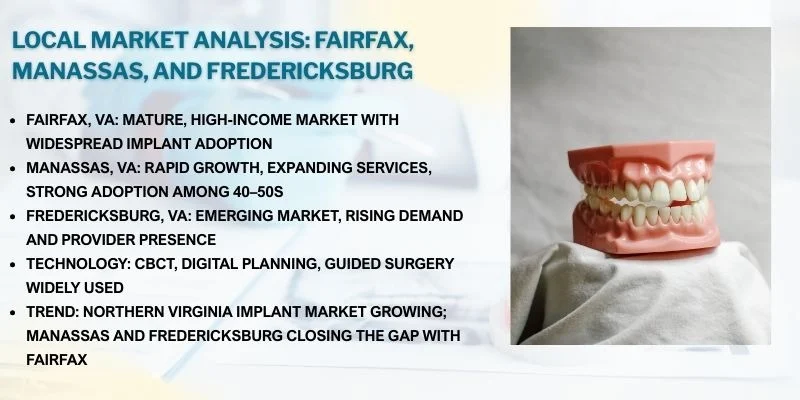
Fairfax County represents one of the most advanced implant markets in Virginia. According to U.S. Census data, Fairfax County has a median household income exceeding $140,000, among the highest in the country. This economic profile significantly influences implant adoption.
In Fairfax:
- Patients are more likely to accept implants as the first recommended option.
- Single-tooth implants are common among middle-aged adults, not just seniors.
- Full-arch implant solutions are increasingly chosen by older adults replacing long-term dentures.
Provider density is extremely high. Virginia workforce reports indicate that over 40 percent of the state’s dentists practice in Northern Virginia, with Fairfax being a major concentration.
Most implant-capable practices in Fairfax routinely use CBCT imaging, digital planning, and guided surgery.
Demand here is stable and high, with growth driven more by population aging and replacement of older dental work than by new market entry. Fairfax is best described as a mature implant market where implants are normalized rather than emerging.
Manassas: Rapid Growth Within Northern Virginia
Manassas, while smaller than Fairfax, benefits from its location within the Northern Virginia economic corridor. Census data shows Manassas has a younger population than Fairfax, with a median age in the mid-30s and a growing base of middle-income families.
Despite the younger demographic, implant adoption is strong:
- Patients in their 40s and 50s increasingly choose implants for single-tooth replacement.
- Awareness of implant options is high due to spillover from Northern Virginia media and provider networks.
From a provider perspective, Manassas has seen:
- Expansion of implant services among general dental practices
- Entry of implant-focused group practices and multi-location providers
- Increased competition, which has improved access and financing options
Demand growth in Manassas between 2018 and 2024 appears faster than Fairfax in percentage terms, reflecting its transition from developing to established implant market.
Fredericksburg: An Emerging Implant Hub
Fredericksburg illustrates how implant demand develops outside major metro cores. With a median household income closer to the national average and a mixed age demographic, implant adoption historically lagged behind Northern Virginia.
That gap has narrowed significantly. According to industry press releases and provider expansion announcements, implant-focused clinics have opened in Fredericksburg since 2022, signaling sufficient unmet demand to support specialized practices.
Key characteristics of the Fredericksburg market:
- Growing retiree population from surrounding counties
- Increased awareness of implants as an alternative to dentures
- Rising availability of CBCT imaging and advanced implant services locally
While implant penetration is still lower than Fairfax or Manassas, Fredericksburg shows one of the strongest growth trajectories in Virginia. By 2026, its implant market is expected to resemble mid-tier Northern Virginia suburbs rather than a secondary market.
Patient-Side Adoption Trends
Across all regions studied, patient adoption follows consistent patterns:
- Age: Seniors remain the largest implant recipients, but middle-aged adults represent the fastest-growing segment.
- Motivation: Patients prioritize chewing function, long-term stability, and avoiding removable dentures.
- Acceptance: According to long-term outcome studies cited by professional associations, patient satisfaction with implants exceeds 90 percent, reinforcing word-of-mouth adoption.
- Barriers: Cost remains the primary obstacle, particularly for multi-implant cases, though financing options have improved acceptance rates.
Provider-Side Adoption Trends
Providers have responded directly to rising demand:
- Implant training among general dentists has expanded significantly since 2018.
- Practices increasingly invest in CBCT scanners and digital workflows.
- Competitive markets have pushed providers to differentiate through technology, credentials, and comprehensive implant services.
- Implant dentistry has become a major revenue driver, encouraging further adoption.
In Virginia, these trends are especially pronounced due to high provider density and patient expectations.
Historical Growth (2018–2024) and 2026 Outlook
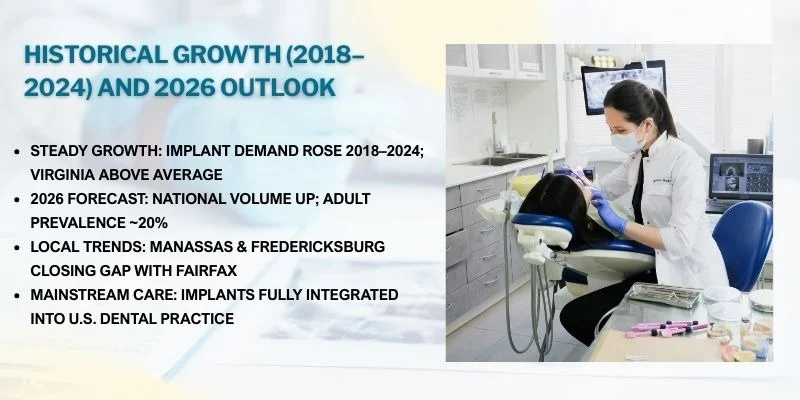
Between 2018 and 2024, dental implant demand increased steadily at national and state levels, with Virginia tracking slightly above the national average. Market research firms project continued annual growth through at least 2026.
By 2026:
- National implant procedure volume is expected to exceed current levels by a meaningful margin.
- Implant prevalence among adults with missing teeth is projected to approach 20 percent or higher, consistent with academic projections.
- Local markets like Manassas and Fredericksburg are expected to continue closing the gap with Fairfax.
Dental implants are no longer an emerging treatment. By 2026, they will be fully embedded in standard dental care pathways across most U.S. markets.
Conclusion
Dental implant demand in the United States and Virginia reflects long-term demographic, clinical, and technological shifts rather than short-term trends.
Fairfax demonstrates what a mature implant market looks like, Manassas shows rapid normalization, and Fredericksburg illustrates early-to-mid stage expansion.
Taken together, these markets confirm that dental implants are transitioning from a specialist-driven service to a core component of modern dentistry, with adoption continuing to rise on both the patient and provider sides.
References
- Journal of Dental Research – Trends in Dental Implant Use in the United States
- American Academy of Implant Dentistry – Implant Success Rates and Utilization
- Centers for Disease Control and Prevention – Oral Health and Tooth Loss Data
- U.S. Census Bureau – Population and Aging Statistics
- Grand View Research – U.S. Dental Implant Market Reports
- Virginia Dental Association – Workforce and Practice Distribution Data
- America’s Health Rankings – Dentist Density and Access Metrics